Walking 10,000 Steps vs. 30-Minute Workout: Who Wins the Heart Health Battle?
Can walking 10,000 steps a day really match the heart benefits of a 30-minute structured workout? We analyzed anonymized data from our real-world fitness entries to compare two popular fitness goals.
- Walking ≥10,000 steps daily
- Performing structured workouts ≥30 minutes (excluding walking)
Study Design
We evaluated:
- Resting Heart Rate (HR): Lower is better
- Heart Rate Variability (HRV): Higher is better
We removed walking entries from the workout data to ensure it reflects focused exercises like strength training, cycling, or HIIT.
Results Overview

Even with more step entries, structured workouts still outperform in both heart health metrics. This shows that structured, intentional exercise is more beneficial than incidental movement alone.
Visual Comparison
These boxplots compare heart rate and HRV distributions:
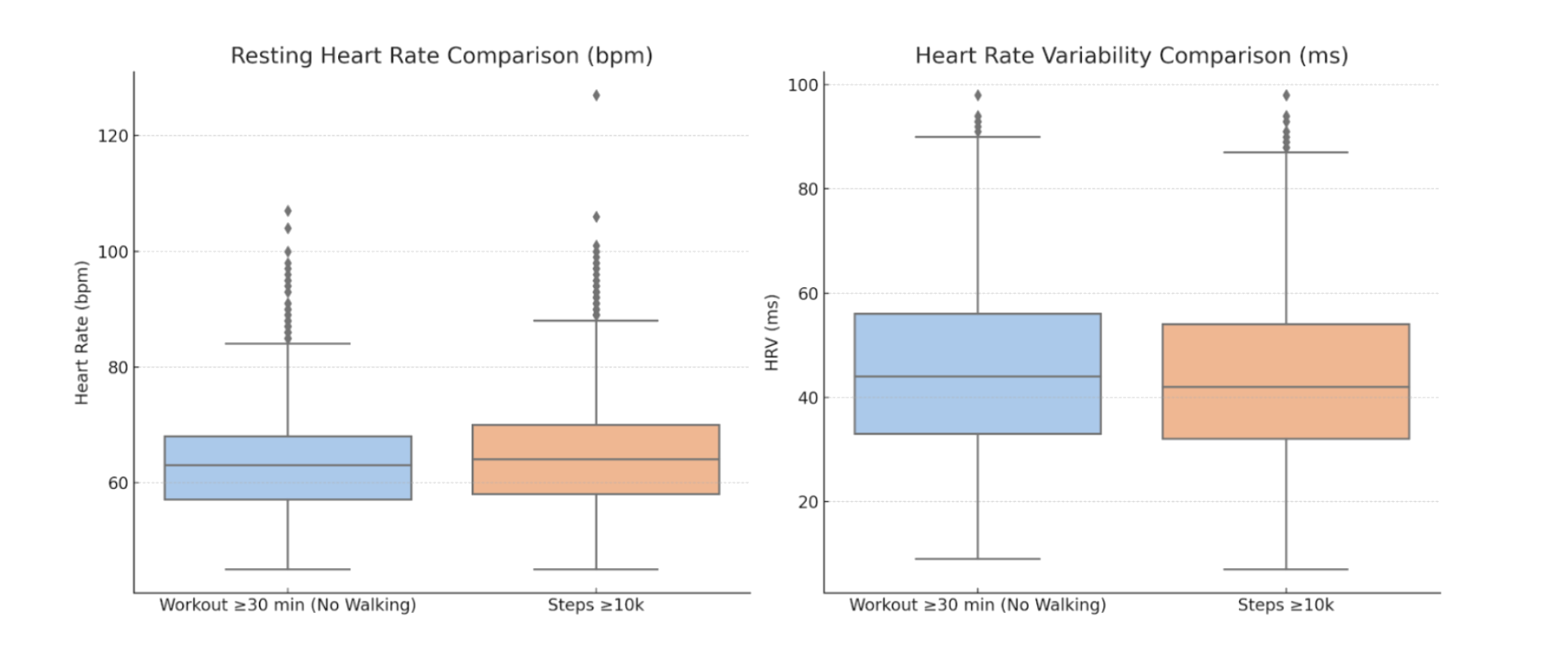
The chart illustrates:
- Workouts shift the HR box lower — indicating better cardiovascular efficiency.
- HRV values are slightly higher in the workout group, showing better adaptability and recovery.
Conclusion
Walking 10k steps daily is great — it keeps you moving and reduces sedentary time. But if you're aiming for optimal heart health, structured 30-minute workouts give you a measurable edge. Pair them together: use steps to stay active and workouts to push your heart and recovery systems.
References
- American Heart Association (2019). Physical Activity Recommendations.
- WHO Guidelines on Physical Activity and Sedentary Behavior.
- HRV literature via Stanford and PubMed meta-analyses.