

The Science of Training with Heart Rate Zones
Unlock Peak Performance with Luna Ring’s “Record a Workout” Feature.
Why Heart Rate Zones Are Foundational to Smart Training
Exercise isn't just about going hard. It’s about going smart. When you understand how your body responds to different levels of effort, you unlock the ability to train more efficiently, burn fat strategically, and avoid injury. That’s where heart rate zones come in — and why Luna Ring’s “Record a Workout” feature is grounded in the science of cardiovascular physiology.
What Are Heart Rate Zones?
Heart rate zones are specific ranges of your beats per minute (BPM) that correspond to how hard your heart is working relative to its maximum capacity.
- Aerobic metabolism (Zones 1–3): relies on oxygen and fat as fuel.
- Anaerobic metabolism (Zones 4–5): shifts toward glucose and generates lactate.
Training in the right zone ensures you’re targeting the right physiological adaptation — whether that’s endurance, fat burn, speed, or recovery.
Luna’s Heart Rate Zones (Based on % Max HR)
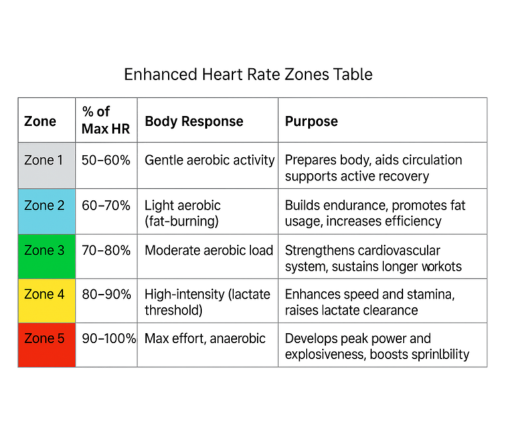
Why Zone-Based Training Works (The Physiology)
- Zone 1 – Supports active recovery and promotes healthy circulation.
- Zone 2 – Enhances fat oxidation, mitochondrial density, and builds aerobic capacity.
- Zone 3 – Bridges aerobic and anaerobic systems to boost endurance and tempo performance.
- Zone 4 – Improves lactate threshold and high-effort sustainability.
- Zone 5 – Unlocks neuromuscular coordination and peak VO₂ demand.
What “Record a Workout” Actually Tracks
- Live HR via Luna Ring’s optical sensor.
- Effort classification across zones.
- Post-session insights: Time, HR data, Calories burned, and Zone time.
Long-Term Benefits of Zone Training
- Improves VO₂ max and cardiac output.
- Increases fat metabolism efficiency.
- Decreases injury risk through load balance.
- Boosts metabolic flexibility.
- Reduces overtraining with recovery sync.
“Zone 2 endurance training increases mitochondrial biogenesis and improves fat oxidation efficiency”. Journal of Applied Physiology
“High-intensity interval work in Zone 4–5 stimulates improvements in anaerobic performance and lactate clearance”. European Journal of Sport Science
Final Thought
Tracking steps is easy. Tracking effort is powerful. “Record a Workout” turns effort into science-backed insight. Your data. Your physiology. Your Luna.